
Sex Offender Checks in Norfolk City
The Virginia Sex Offender and Crimes Against Minors Registry is the first place to search for a public Norfolk City registration record. Virginia State Police manages the system. An ordinary public search is free and needs no account. A name can narrow the results when the person is known. An address, city, ZIP code, or radius search is more useful for community awareness near a home, school route, park, or other place important to a family.
The portal is one part of a careful check. Confirm that the profile matches the intended person by comparing the name, aliases, age, photograph, address, and conviction details shown. Norfolk Police Central Records or the Norfolk Sheriff may deal with local verification and enforcement, while VSP remains the keeper of the public registry. The Norfolk City Jail current-custody tool and court case search answer different questions. Neither replaces the state sex offender registry, and absence from a jail list does not settle registration status.
Start with the facts already known. A full name helps avoid a broad match. A precise street address supports a proximity search, while a ZIP code casts a wider net. The registry number is the strongest direct search key when it is available.
Why Norfolk City Registry Menus Differ
Norfolk is an independent full-service city under Virginia law. It performs county-equivalent functions, but it is not within a county and contains no smaller incorporated city or town. That structure explains a common registry search snag. A portal may group Virginia cities and counties in the same locality control. When the registry presents that kind of menu, choose Norfolk City. Do not treat Norfolk as part of another county.
Other official systems may simply label the place Norfolk. Both forms can point to the same independent-city jurisdiction. The distinction matters most when a person uses a county filter, compares results from several states, or tries to reconcile a Norfolk address with a court record. Norfolk Police and the Norfolk Sheriff carry local public-safety roles, but VSP runs the statewide registry. A separate Norfolk municipal registry was not documented in the official research.
Note: A locality label is a search filter, not proof that a person lives at the address entered.
How to Search the Virginia Sex Offender and Crimes Against Minors Registry
Use the VSP registry for the primary Virginia search. Its redesigned public portal supports several paths, so the best method depends on the question. A name search tests a known identity. City, county, and ZIP controls scan a broader Norfolk City area. Street-address mode supports a proximity search. The SOR number opens a direct route when that state identifier is known.
- Open the official VSP registry and choose the search method that fits the facts in hand.
- Enter a first and last name, ZIP code, street address, city, Norfolk City locality, or SOR number as the selected mode permits.
- Review the results without assuming that a similar name is the intended person. Compare the public identity and location details.
- Open the matching profile and read the conviction, address, photograph, work or school information, and status notices that VSP publishes.
The official Virginia registry search screen shows the public starting point for these Norfolk City queries.
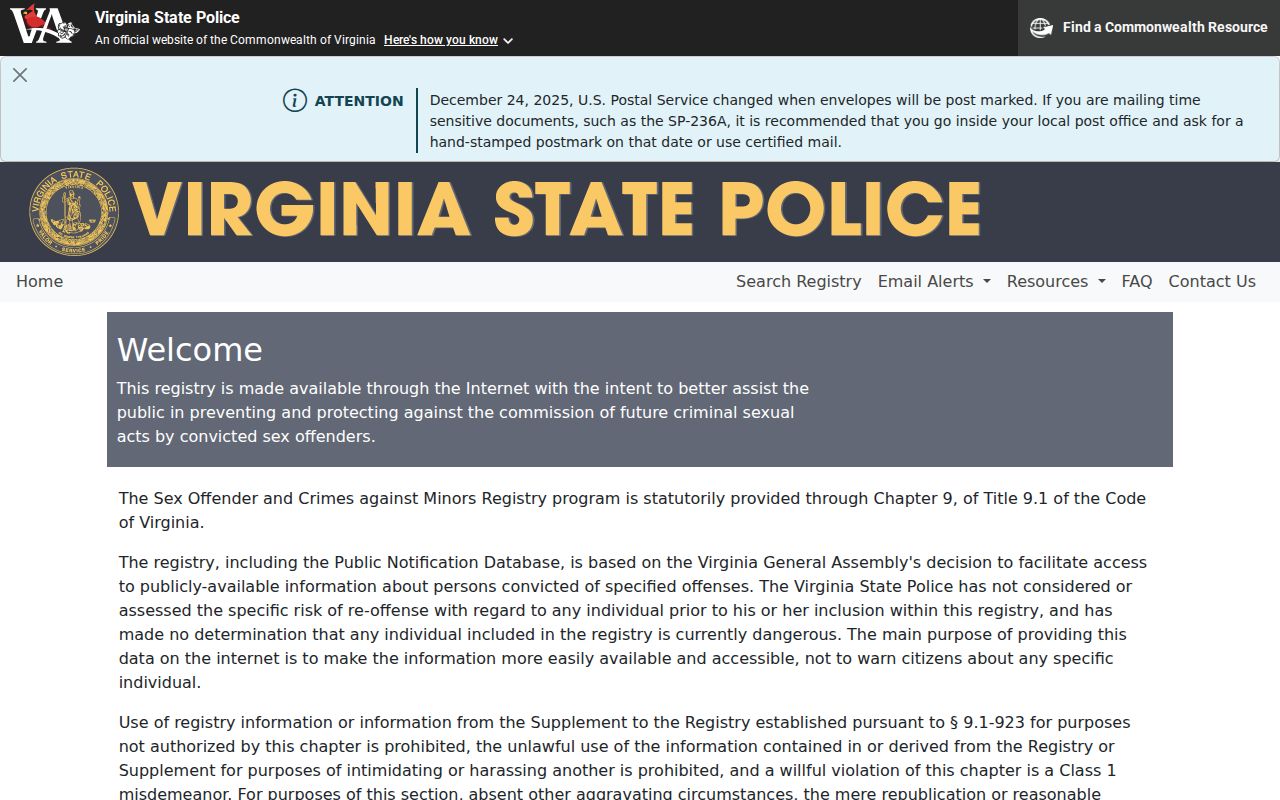
The blank form keeps the focus on search controls and avoids displaying any registrant's identity.
The available controls are not interchangeable. Use the table to match each field to its purpose before submitting a Norfolk City sex offender search.
| Field Label | Type | Required | Notes |
|---|---|---|---|
| First Name / Last Name | Text | Portal-dependent | Used for a name search. |
| ZIP Code | Text | No | Runs a geographic search. |
| Street Address | Text | Radius mode | Supports an address-radius query. |
| City | Text or dropdown | No | Norfolk can be entered or selected. |
| County | Dropdown | No | Select Norfolk City where the control groups Virginia localities. |
| SOR Number | Text | No | Uses the state registry identifier. |
| Email Alerts | Tab | No | Provides proximity or registration notifications. |
Norfolk City Registry Address Searches
An address-radius search and a ZIP search answer different questions. Radius mode begins with one street address and looks outward. That approach is useful when the point of concern is exact. A ZIP query covers a broader postal area, so it can help with wider Norfolk City community awareness but may return results far from the specific place that prompted the search.
City and county controls provide another broad layer. On a Virginia portal, use Norfolk or Norfolk City as the interface directs. Results can change when a filter is broadened, so try more than one reasonable geographic mode if the first result seems incomplete. A missing result is not a cue to confront anyone. It may reflect the selected boundary, the address entered, a move, or the limits of public display.
Virginia's registry also offers email alerts for proximity or registration notices. The alerts can support ongoing awareness after a one-time Norfolk City registry search. They do not turn an old screen capture into a current official record. Return to the live VSP profile when an alert or changed address needs review.
Inside a Registry Profile
Virginia Code §9.1-913 sets the public-display framework. A profile can identify the registrant, describe the qualifying conviction, and show current location details that aid public safety. Read the whole profile. A photograph alone is not enough to resolve identity, and an address result should not be detached from the name, age, aliases, and offense data tied to it.
| Name and Aliases | The registered name and other names authorized for public display. |
|---|---|
| Age and Photograph | Identity details used to distinguish people with similar names. |
| Residential Address | The current residence made public under the registry statute. |
| Conviction | The conviction date, locality, and a brief description of the offense. |
| Work and Higher Education | A current work address and higher-education institution when displayed under §9.1-913. |
| Safety Information | Other authorized facts, including wanted-for-failure-to-register status when applicable. |
A registry profile is not a full criminal case file. It does not replace the signed court order, police report, or Virginia criminal-history report. For the charge path and court outcome behind a Norfolk City matter, the Norfolk City criminal court cases channel holds a different set of records.
Norfolk City Registry Data Boundaries
Collected registration data is broader than the public profile. Virginia law requires agencies to gather identifiers and information about contact methods, internet use, vehicles, work, and school. Section 9.1-913 governs what the public system may show. A Norfolk City searcher should not assume that every item collected under §§9.1-903 and 9.1-906 will appear on the screen.
The Virginia registry duties and public-access chapter supplies the legal source for what is collected, verified, released, and restricted.
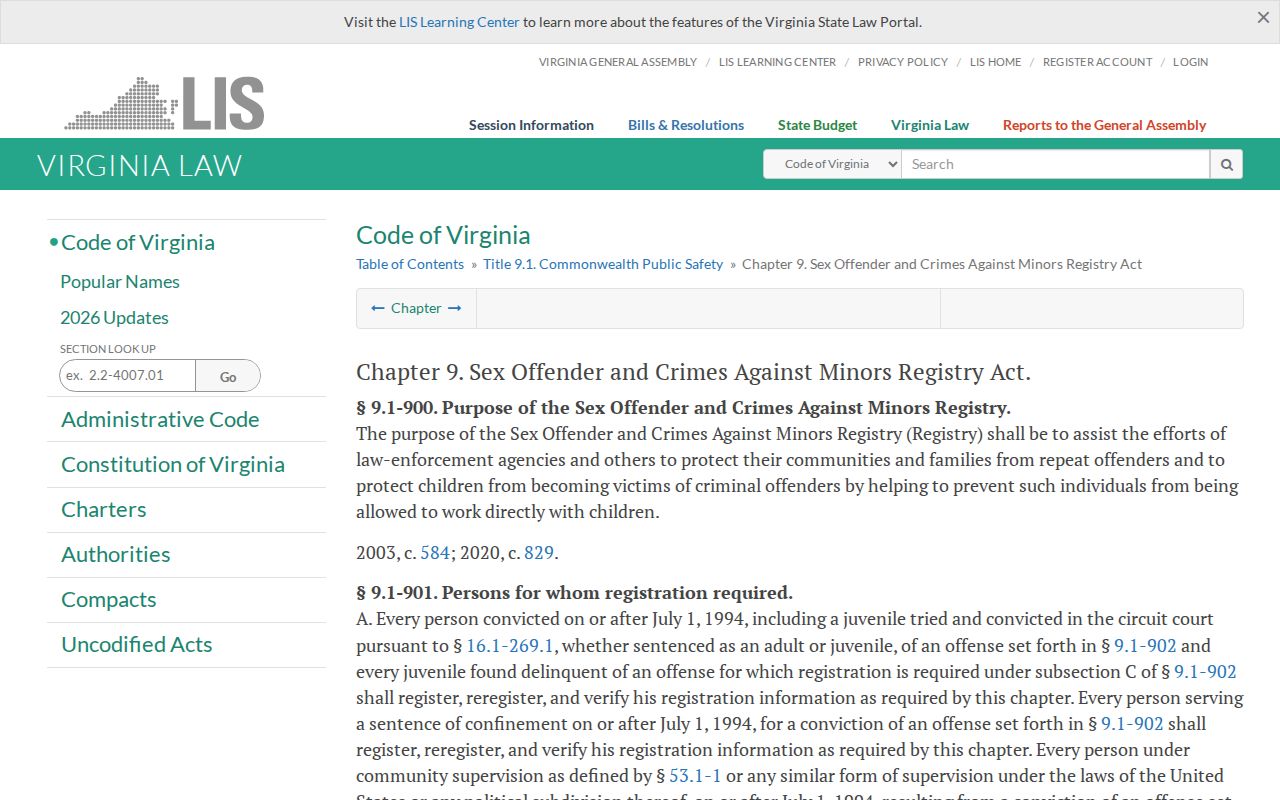
The statute view helps separate a public profile field from data held only for registration and enforcement.
This boundary prevents two common errors. First, a blank field does not prove that the agency never collected the fact. Second, a screen result does not disclose every record held by Norfolk Police, the Norfolk Sheriff, VSP, or a court. Use the public display for its stated safety purpose and rely on the originating office for an official record it maintains.
Virginia Registration Levels and Requirements
Virginia links verification and removal rules to the registrable offense, tier, history, and statutory exclusions. The system is not a simple public-facing chart in which every case follows a fixed 10-year, 25-year, or lifetime label. Section 9.1-902 controls the offense list, §9.1-908 addresses the ongoing duty, and §9.1-910 governs eligible removal petitions. Confinement can toll an applicable period, while repeat registrable history can restrict removal.
| Tier or Category | Verification | Duration or Removal |
|---|---|---|
| Tier I | Generally annual, including the birth month | Continues unless a court grants an eligible §9.1-910 petition, typically available only after 15 years and the required showing. |
| Tier II | Generally annual | Uses the same statute-driven removal framework, subject to offense and history exclusions. |
| Tier III or Murder | Four times yearly at three-month intervals | Lifetime registration; no ordinary §9.1-910 removal. |
| Certain Repeat or Failure Cases | Frequency can increase | Repeat registrable history limits removal, and confinement can toll the applicable period. |
Fifteen years is a threshold for an eligible petition, not automatic deletion from the registry. A petitioner must show substantial compliance, no later registrable conviction, and no current threat. Tier III, murder, multiple registrable offenses, and other listed exclusions remain barred. Section 9.1-909 may reduce verification frequency in some cases, but that change is not removal.
Note: The court decides eligible removal; neither an elapsed date nor a less frequent check-in erases a Norfolk City listing.
Norfolk City Registry Alerts and NSOPW
The VSP Email Alerts tab is the Virginia tool for proximity or registration notices. It fits a Norfolk City household that wants updates after an address-based search. For a person or location that may cross state lines, use the official National Sex Offender Public Website. NSOPW is a government search across participating jurisdictions, not a substitute for the fuller Virginia source.
The national form accepts a first and last name or a ZIP code. County and city or town are optional, and a query can use up to five ZIP codes with all jurisdictions selected. Radius mode requires an address, city or town, state, and distance. Radius results depend on the supplying jurisdiction having coordinates. Result columns can include offender, age, aliases, and address.
The NSOPW nationwide fallback form illustrates the broader search layer available beyond Norfolk City and Virginia.
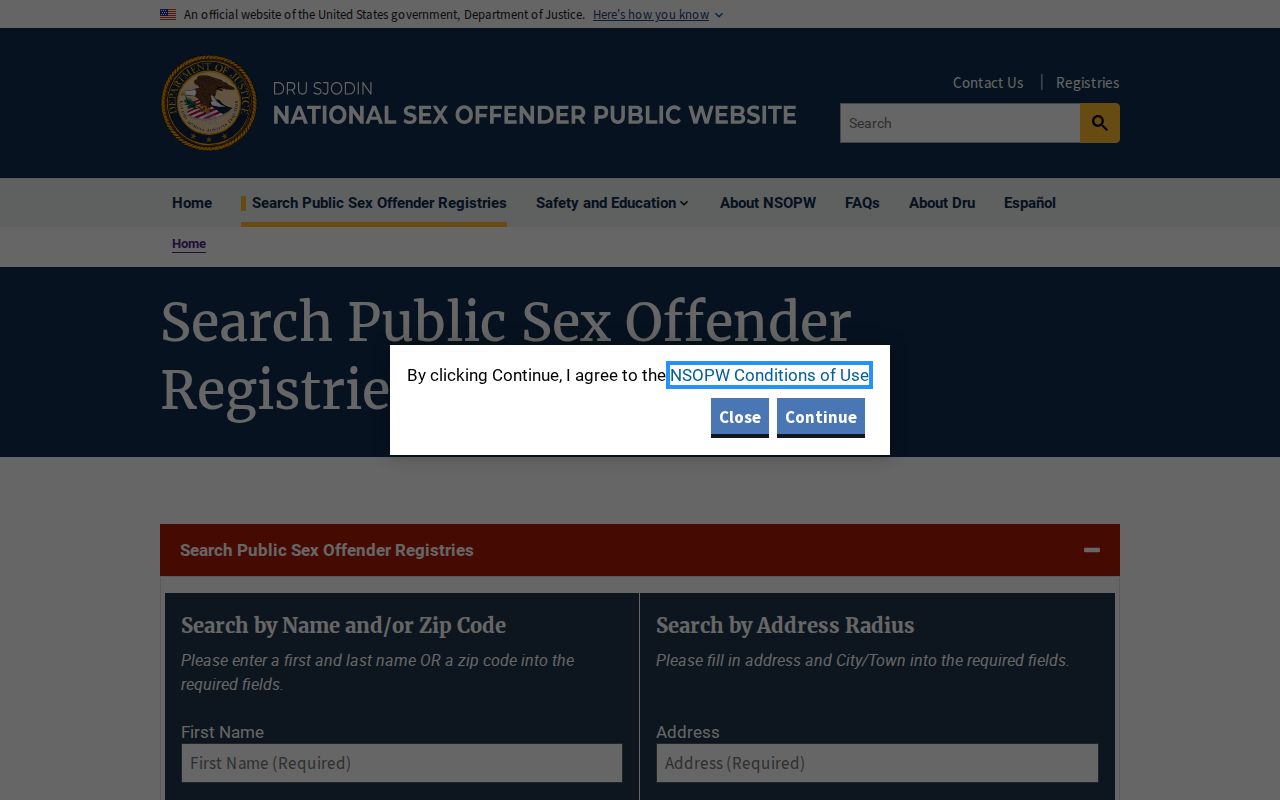
The empty government form permits a privacy-safe comparison of national and Virginia search options.
Community Notification and Lawful Use
Registry information supports personal and family safety, neighborhood awareness, and sound planning. VSP's public search and email alerts provide the official notification channels documented for Norfolk City. Review live records because addresses and status can change. Keep a result in context, and never treat a shared image or an old copied profile as more reliable than the current state page.
Virginia draws a firm line between awareness and abuse. Do not threaten, pursue, shame, or confront a person or household based on registry data. If the facts suggest a registration problem, send the concern to law enforcement or VSP. Trained officials can compare public information with records that are not open to general viewing.
Virginia misuse warning: Virginia Code §9.1-918 prohibits using registry information to intimidate or harass. A willful violation is a Class 1 misdemeanor.
Reasonable republication by itself, without aggravating facts, is not intimidation or harassment under the statute. That rule does not excuse threats or vigilante conduct. Share only what serves a real public-safety need, and preserve the source and date so another reader can return to the official record.
Reporting Norfolk City Registry Concerns
When a Norfolk City address or status appears inconsistent, record the exact public profile, the date viewed, and the specific fact that prompted concern. Do not investigate at the residence. VSP Sex Offender Registry staff can be reached at 804-674-2825 or sor@vsp.virginia.gov. Norfolk Police or the Norfolk Sheriff may address local verification and enforcement matters, but no exact local registration counter hours or fee were confirmed in the official sources.
Describe the issue without adding guesses. A changed address, a wanted-for-failure-to-register notice, or suspected noncompliance can be reported to law enforcement or VSP. Officials can test it against the full registration record. For an urgent threat, use the proper emergency channel rather than a records portal.
This route protects both safety and accuracy. It gives the agency that maintains or enforces the record a clear fact to check, while keeping a Norfolk City registry search from becoming direct contact or harassment.