
Checking Criminal History in Norfolk
Start with the Norfolk office that created the record. Police Central Records holds local incident and arrest reports. The Norfolk Sheriff holds jail booking and present-custody information. General District and Circuit Court clerks keep case files and final orders. The Virginia Department of State Police maintains the statewide Central Criminal Records Exchange. Those sources overlap, but none replaces the others. A Norfolk police report tells what officers recorded, while the court file shows how a filed charge ended.
- Use the Norfolk Police arrest dataset for a recent arrest when its short time window fits.
- Request the report from Police Central Records or the Public Safety FOIA queue when the open-data view is too limited.
- Search Norfolk General District or Circuit Court in OCIS for filed charges, hearings, pleas, and dispositions.
- Check the Norfolk Sheriff lookup for current jail custody, then call or submit Sheriff FOIA for older booking material.
- Use VSP's SP-167 process when the goal is a consent-based statewide Virginia repository report.
Online gaps call for a change of channel, not a quick conclusion. A daily feed can expire, a person can leave the Norfolk jail, and a case can move from General District to Circuit Court. Search by the name used on the source paper and retain any incident, booking, or case number. Norfolk's state repository and record-correction routes require their own official processes.
Norfolk Is Its Own Records Jurisdiction
Norfolk is an independent incorporated city under Virginia's Constitution. It is not inside a county, and no county government controls its police or local constitutional officers. Norfolk also contains no subordinate incorporated city or town. Downtown, Ghent, Brambleton, and Ocean View are neighborhoods, not separate municipalities with their own police departments or courts. This structure is why official search menus may say “Norfolk City” even though local agencies use “City of Norfolk.”
That distinction prevents several common routing errors. There is no county sheriff, county court, or city-within-a-county records desk for Norfolk. Norfolk Police handles the city's general police records. The Norfolk Sheriff runs the city jail and sheriff functions. Virginia's state judiciary operates the Norfolk courts. A record request should name the real custodian and the exact file sought rather than asking for a broad county background report that no local office produces.
Norfolk Police Department Records
The Norfolk Police Department is the city's sole general-purpose police department. Its Central Records Division maintains offense and accident reports, warrants, criminal-history services, and related files. Headquarters is at 100 Brooke Avenue, but public records service is at the Police Operations Center, 3661 E. Virginia Beach Boulevard. Central Records can be reached at 757-664-7012. Counter hours are 9 a.m. to 3 p.m., which means a trip to headquarters may put a requester at the wrong Norfolk building.
The official Norfolk Police page identifies the department and its city role.
The department page provides agency context, while the Central Records counter and Public Safety request channels are the routes for Norfolk police files.
Formal requests may be filed through JustFOIA by choosing Public Safety, or sent to foia@norfolk.gov. Mail goes to FOIA Request, Norfolk City Hall, 810 Union Street, Suite 409, Norfolk, VA 23510. VFOIA calls for a response within five business days, though a seven-business-day extension can apply. Investigative files can have different timing and exemptions. Ask for an estimate when the search or redaction work could be substantial.
Norfolk Records at Police Operations
The Norfolk public counter requires two forms of identification. One must be a primary ID, such as a driver license, federal ID, military ID, or state ID. A second may be a birth certificate, passport, Social Security card, or voter registration. Bring both before requesting a local check, report, or fingerprints. Norfolk accepts cash, company checks, Discover, Mastercard, or Visa credit, plus Mastercard or Visa debit for these counter services.
The Norfolk records-counter instructions show the counter hours and identification rules.
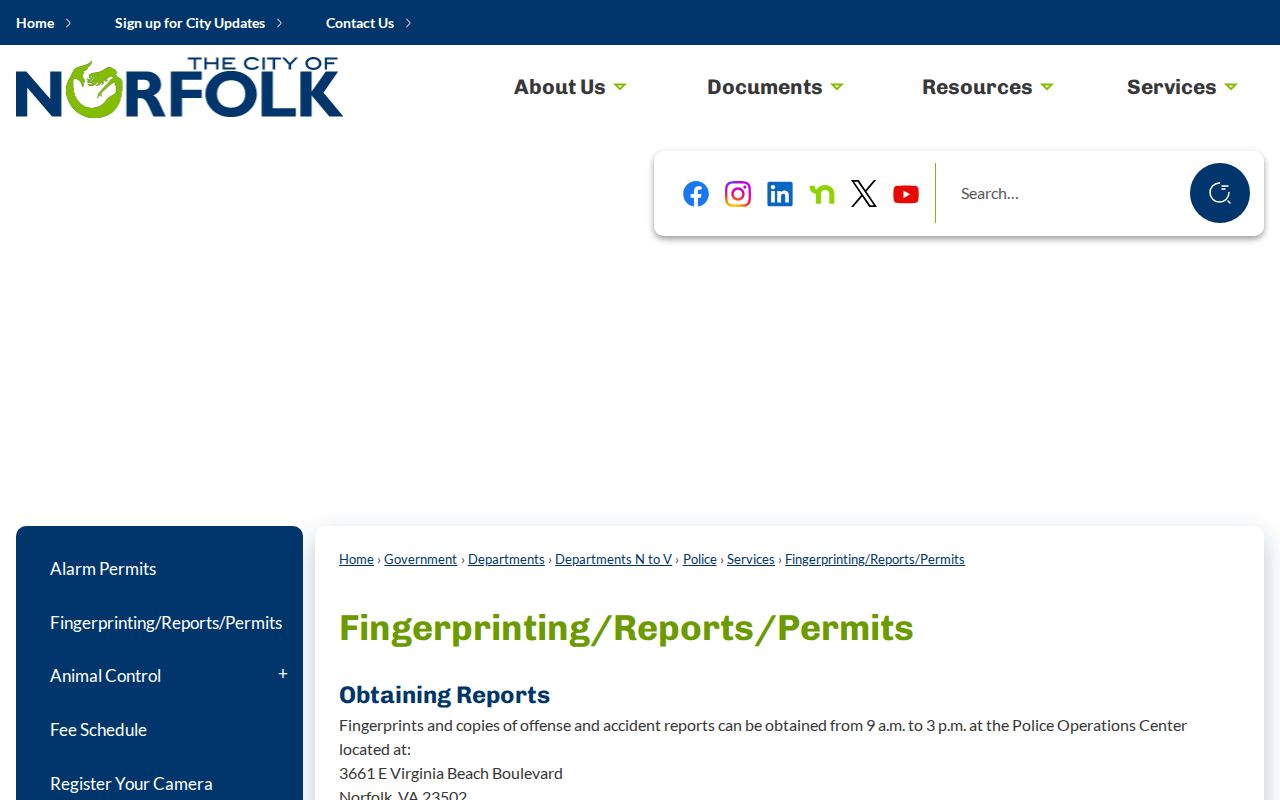
Those requirements apply at the Police Operations Center and should be checked before an in-person Norfolk records visit.
A citizen online report is a different tool. It creates a new report for qualifying nonemergency events with no known suspect or evidence, rather than finding a copy of an existing record. The questionnaire checks location, emergency status, injury, age, and contact details. A completed submission generates a case number and a printable unapproved report for later Norfolk Police review.
Norfolk Local Check Versus SP-167
A $10 Norfolk local criminal check has city-only scope. It should not be described as a full Virginia criminal history. The VSP SP-167 is the statewide name-based repository product for self-review or another consent-based request. Its subject section must be signed and notarized. When results go to another requester, the recipient section also requires the stated signatures and notarization. The completed form and $15 payment are mailed to VSP CARE, and the usual turnaround is about 15 business days after receipt. There is no same-day or expedited service.
The Norfolk Police fee schedule lists the city's current records and fingerprint charges.

The fee schedule helps separate the Norfolk service from the mailed VSP repository request.
| Norfolk or Virginia Product | Fee | Scope and Channel |
|---|---|---|
| Norfolk local criminal check | $10 | City-only check at Police Central Records |
| Norfolk offense report | $10 | Police report from the local counter |
| Norfolk accident report | $10 | Police accident file from the local counter |
| Norfolk fingerprint card | $10 first; $5 more | Card service with two IDs, not a history report |
| VSP SP-167 | $15 | Notarized, printed, mailed Virginia repository request |
Norfolk Arrests and Bookings
Norfolk Police publishes an official rolling 24-hour arrest dataset that updates daily. It supports search, filter, sort, export, and OData access without a login. Fields include first and last name, height, weight, hair, eye color, sex, race, arrest date, and charge. Its short window is crucial. Once an entry drops out, use Norfolk Police FOIA, the Sheriff booking channel, or the court record. The feed reports an arrest allegation, not a conviction.
After a Norfolk arrest, the police record and jail record split. NPD creates the arrest or incident file. The Norfolk Sheriff creates the City Jail admission and custody record. The current-inmate lookup searches by first name, last name, or ID number and can return the inmate ID, booking date, current charges, and booking photo. It is a present-custody tool, not a historical arrest archive.
If the jail search is unavailable or empty, call 757-664-4700 or use Sheriff FOIA for historical booking material. Release, transfer, spelling, timing, and a system outage can all explain a miss. Then check OCIS for the filed case. The detailed Norfolk arrest lookup follows each official arrest and booking channel without treating a charge as proof of guilt.
Five Years of Norfolk Incident Records
Norfolk's incident dataset retains a rolling five years of police reports and updates daily. It can be searched by Incident ID, Offense, generalized block address, street, occurrence date and hour, census tract, zone, district, report area, day of week, or neighborhood. Victim and juvenile names are excluded, and locations are generalized. The result is useful for finding a report reference or viewing local reporting patterns, but it is not a name-based criminal history and does not prove a case outcome.
The official Norfolk incident dataset displays those fields and filters.
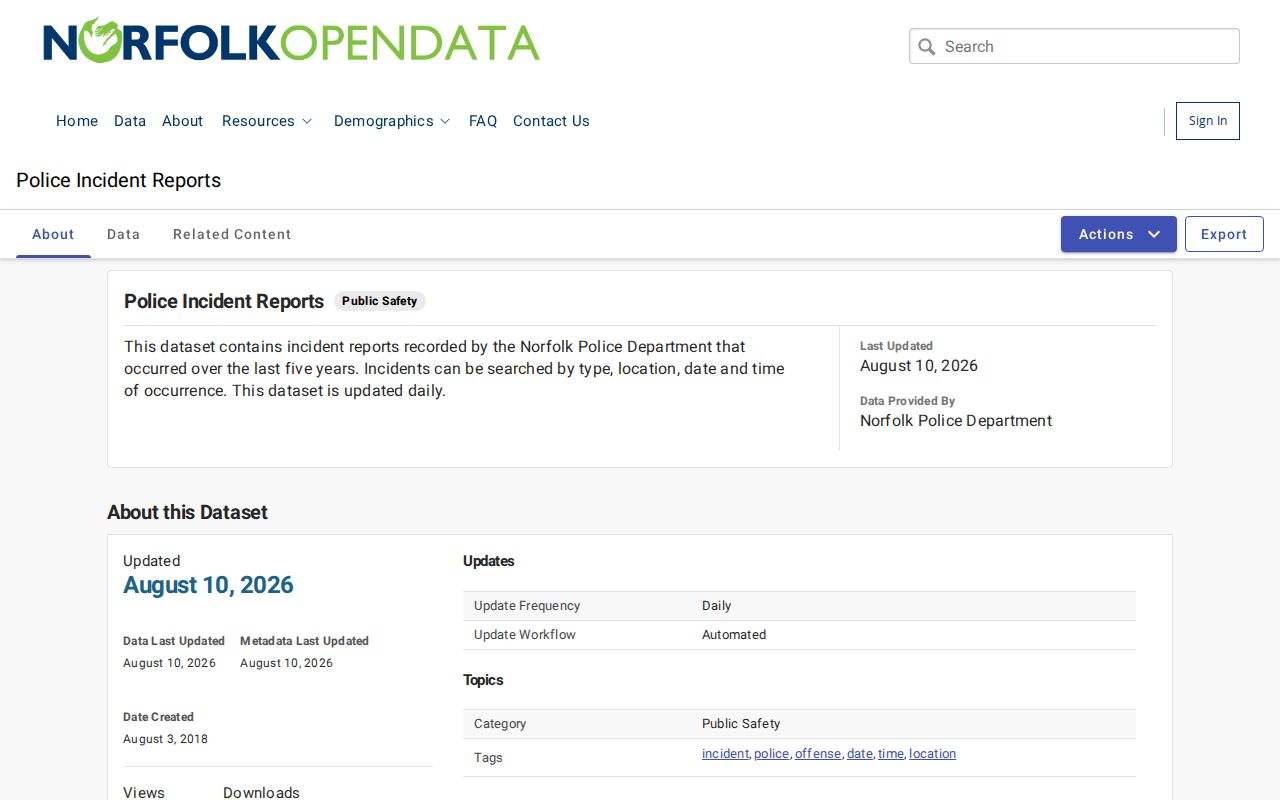
The interface helps narrow a Norfolk incident before requesting the underlying report from Central Records.
The separate Norfolk crime map covers a rolling 90 days and searches crime type near an address, landmark, or ZIP code. It uses approximate locations, supports maps and summaries, and prohibits commercial use. P3 Tips is an anonymous tip tool, while MyNorfolk handles city service requests. Neither app searches criminal records, warrants, or jail bookings.
Municipal Court Records in Norfolk
Norfolk does not have a municipal court. Norfolk General District Court is the Virginia court that performs the city's local-offense role. It hears misdemeanors, city ordinance and traffic cases, plus bond matters, arraignments, and felony preliminary hearings. Felony trials and appeals move to Norfolk Circuit Court. Juvenile cases and adult family or household-member matters go to J&DR Court, where public access is much more restricted.
| Court Name | Norfolk General District Court, not a municipal court |
|---|---|
| Case Types Heard | Misdemeanors, city ordinances, traffic matters, arraignments, bonds, and felony preliminary hearings |
| Case Lookup Channel | OCIS statewide search or the Norfolk GDC locality portal; clerk at Room 3202 |
| What the Docket Shows | Case number, defendant, charge, Code section, offense and hearing dates, plus detail sections |
| Copies & Fees | Ask the GDC clerk for the available plain or certified record and current cost |
The Norfolk GDC clerk is at 150 St. Paul's Boulevard, Room 3202. The main number is 757-664-4910, with criminal lines at 757-664-4915 and 757-664-4916. Use the Norfolk criminal court cases resource for the full GDC-to-Circuit search path and case-file fields.
Norfolk Arrest Records Reach the Jail
The Norfolk booking chain begins with arrest and transport, followed by identity and property intake, fingerprints, a photograph, charge or warrant entry, health screening, classification, and a magistrate's bail decision. An adult held in custody then reaches a General District Court arraignment. Pretrial Services may interview an eligible adult at the jail, verify details, perform a criminal-history and risk assessment, and make a recommendation. A judicial officer decides placement.
Norfolk City Jail remains at 811 E. City Hall Avenue, despite the Sheriff's administrative move to 538 Front Street during renovations in April 2026. The jail and administration addresses serve different needs. Current custody belongs in the Sheriff lookup. Older jail records go through Sheriff phone or FOIA. State prison or supervision belongs in the VADOC locator, while federal custody belongs in the Bureau of Prisons system.
This handoff explains why a Norfolk Police arrest can vanish from the 24-hour feed while a court case remains. It also explains why the jail tool can stop showing someone after release or transfer. The filed court charge and final order must be checked before drawing a conclusion from the first arrest label.
Where Norfolk Records Go
A Norfolk incident begins as a police record. If an arrest follows, the Sheriff creates a separate jail admission. A magistrate and the trial courts add bail, charging, hearing, plea, disposition, and sentence records. Clerks report qualifying dispositions to the Virginia Department of State Police Central Criminal Records Exchange under state law. District-court conviction reporting may wait until the appeal period ends, and amended or reversed results also must be reported.
Record flow: Norfolk Police Department › Norfolk Courts › Virginia Department of State Police CCRE
For something that happened today, start with the Norfolk arrest or incident data and current jail search. For the filed charge and outcome, move to General District or Circuit Court. For a statewide identity-linked history, use SP-167. Timing and identity matching can cause lag among these sources, so a clerk-certified disposition is stronger than an online screenshot when a Norfolk record looks wrong.
A correction starts with the office that supplied the disputed item. Obtain the signed disposition from the Norfolk clerk, then send it to the reporting police agency or VSP as appropriate. One office cannot rewrite another custodian's source file merely because the systems exchange data.
Norfolk Real-Time Records and Crime
Norfolk's Real-Time Crime Center became fully operational in May 2024. Its first-year release described a unit staffed seven days a week from 7 a.m. to 3 a.m. Command staff, sworn personnel, and civilian analysts combine cameras, license-plate readers, 911 and computer-aided dispatch data, field reports, and records. This is an operational crime-analysis program, not a public criminal-record search portal.
The Norfolk Real-Time Crime Center page identifies the records and technology joined by the program.
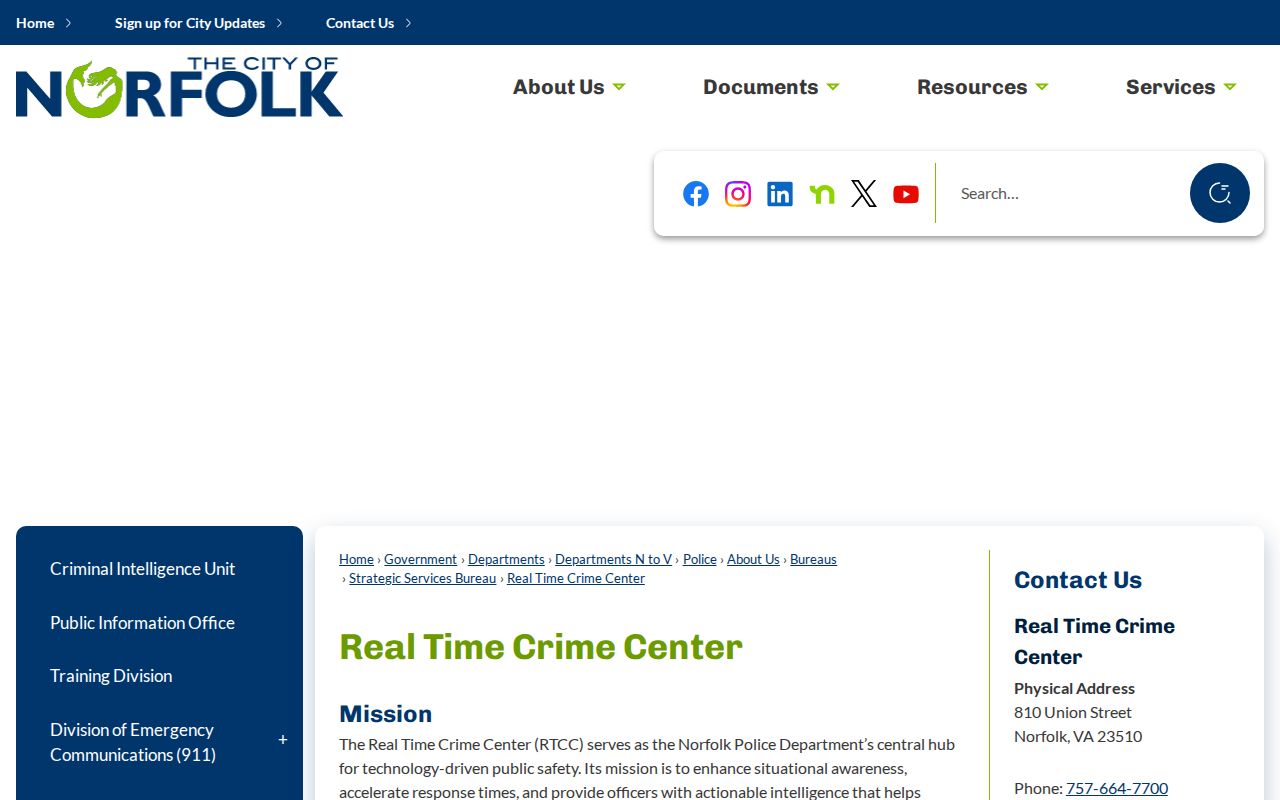
The program adds current context to Norfolk records governance, but public release still depends on VFOIA, privacy limits, and investigative exemptions.
Official 2025 figures reported 26 homicides, 56 nonfatal shootings, an 11 percent drop in violent crime, a 17 percent drop in property crime, and a 41 percent drop in stolen cars. Those aggregate Norfolk measures describe a reporting period. They must not be used to judge a person or infer that a neighborhood resident has a record.
Public Access Rules in Norfolk
The Virginia Freedom of Information Act governs access to existing Norfolk city and police records, subject to exemptions. A requester should describe the record, date range, names, addresses, and incident or case number when known. Norfolk may charge actual search, review, redaction, copy, media, and production costs. City copy rates include $0.15 for a black-and-white page and $0.25 for a color page. An estimate above $200 can require a deposit.
Access does not mean that every detail must be released. Norfolk may redact victim, witness, 911-caller, juvenile, safety-sensitive, and active-investigation information. Court confidentiality rules restrict J&DR material. Sealed or expunged records are not ordinary public files. VSP repository dissemination follows separate criminal-history law, so a Norfolk police FOIA request does not substitute for SP-167.
Key Statutes:
Virginia Freedom of Information Act establishes access to existing public records while preserving statutory exemptions.
Virginia Code §2.2-3706 governs law-enforcement records, including adult arrest information and limits tied to safety and investigations.
Virginia Code §19.2-389 limits dissemination of Central Criminal Records Exchange history to authorized recipients and purposes.
Ask the record's originating office to explain a redaction, denial, or missing result. For Norfolk court records, contact the clerk rather than City FOIA. For jail booking, use the Sheriff channel. That custody-based approach is faster and keeps the request within the rules that apply to the actual file.